
Marine Collagen vs Bovine Collagen: What’s the Difference?
Collagen labels almost always tell you where the collagen came from, and the two names you’ll see most are marine and bovine. If you’re comparing marine collagen vs bovine collagen, the differences come down to source, collagen types, diet preferences and allergies. Here’s a clear, no-hype comparison, and why HealthyHome AMAZE uses marine collagen.
healthyhome.world is run by All In Enterprises, LLC, independent HealthyHome distributors. We may earn a commission when you order through our links. This is general education, not medical advice.
Where each one comes from
- Marine collagen is made from fish, typically the skin and scales.
- Bovine collagen is made from cattle, typically hides and bones.
Both are usually processed into hydrolyzed collagen (collagen peptides), which breaks the long protein into smaller pieces that dissolve easily. Once digested, both supply the amino acids collagen is known for, such as glycine, proline and hydroxyproline.
Collagen types: a common talking point
There are 28 known types of collagen. Type I is by far the most common in the body, making up about 90% of it, and it gives structure to skin, bones, tendons and ligaments. Marine collagen is generally known as a rich source of type I, which is why it’s popular in skin-focused products. Bovine collagen is often described as types I and III. Product to product, though, the label matters more than the source, because formulas vary.
According to HealthyHome, AMAZE contains four key types: I, II, V and IX. Type II supports flexibility in joints, type V supports healthy skin, nails and hair, and type IX supports cartilage formation and function. For a closer look, see AMAZE collagen ingredients.
Diet, faith and allergy considerations
For many people, this is the deciding factor:
- Pescatarian? Marine collagen fits; bovine doesn’t.
- Avoiding beef or pork for religious or personal reasons? Marine collagen is often the easier fit. Check certifications on the specific product if that matters to you.
- Fish or shellfish allergy? Marine collagen is fish-derived. Read the label carefully and talk with your physician before trying it.
- Vegan? Neither one. Collagen is an animal protein; “vegan collagen” products contain building-block nutrients, not collagen itself.
Taste and texture
Unflavored bovine powders are often described as neutral. Marine collagen has a reputation for a faint taste in plain powders, which is one reason marine collagen often comes flavored. AMAZE is a Lemon Berry liquid, so this isn’t something you’ll notice in a packet.
Side by side
| Marine collagen | Bovine collagen | |
|---|---|---|
| Source | Fish | Cattle |
| Commonly associated types | Mainly type I | Types I and III |
| Pescatarian-friendly | Yes | No |
| Allergy note | Avoid or ask your physician if allergic to fish | Check for beef sensitivities |
| Common formats | Liquids, powders, capsules | Powders, capsules |
Is one “better”?
Neither source is a clear winner for everyone. The better question is which product matches your diet, your goals and your routine, and whether you’ll take it consistently. Harvard’s Nutrition Source has a balanced overview of what collagen research does and doesn’t show.
Why AMAZE uses marine collagen
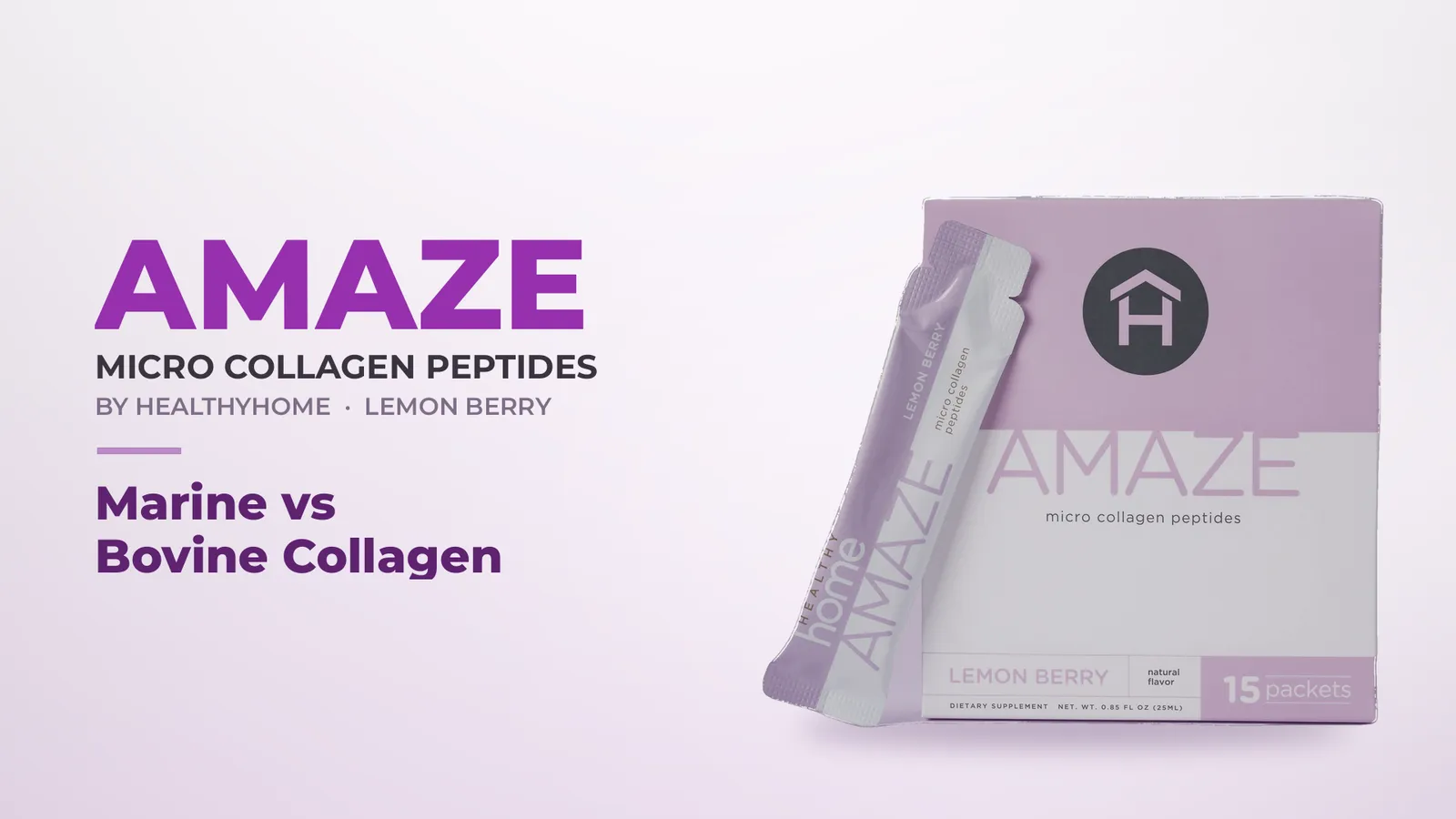
HealthyHome describes marine collagen as one of the cleanest collagen ingredients available and includes it in AMAZE to support skin elasticity and hydration.* Each 25 ml Lemon Berry packet provides 5,000 mg of marine collagen and 5 g of protein, with hyaluronic acid (as sodium hyaluronate) to support skin moisture.* HealthyHome’s Microzen™ technology produces micro-sized peptides that, according to HealthyHome, may provide higher bioavailability than regular collagen.* The label badges list AMAZE as gluten-free, dairy-free and nut-free. Prefer a liquid? Our comparison of liquid collagen vs powder covers that choice.
AMAZE is available as single boxes of 15 servings in HealthyHome’s online shop. HealthyHome’s suggested use is one 25 ml sachet a day. Each box has 15 servings, so 2 boxes make a 30-day supply and 6 boxes (90 sachets) make a 3-month supply. See the AMAZE page for details. If you’re pregnant or nursing, the sheet recommends consulting your physician before using any supplement.
More on AMAZE: AMAZE collagen guide: collagen facts and the four collagen types · AMAZE by HealthyHome
Marine collagen vs bovine collagen: FAQ
What is the difference between marine and bovine collagen?
Marine collagen comes from fish and is mainly associated with type I collagen. Bovine collagen comes from cattle and is usually described as types I and III.
Is marine collagen better than bovine?
Neither is best for everyone. Choose based on your diet, allergies and the product’s label, then take it consistently.
Is AMAZE marine or bovine collagen?
AMAZE uses marine collagen: 5,000 mg per packet. HealthyHome says it contains collagen types I, II, V and IX.
Can I take marine collagen with a fish allergy?
Marine collagen is fish-derived. If you have a fish allergy, talk with your physician before taking it.
How much AMAZE do I need for a month?
HealthyHome’s suggested use is one 25 ml sachet a day. Each box has 15 servings, so 2 boxes make a 30-day supply and 6 boxes (90 sachets) make a 3-month supply.
healthyhome.world is operated by All In Enterprises, LLC, independent HealthyHome distributors. It is not owned or operated by HealthyHome. AMAZE is a HealthyHome product; Microzen™ is HealthyHome’s mark. HealthyHome product names and trademarks belong to HealthyHome, LLC. Product details summarize HealthyHome’s original-formula AMAZE product information sheet (25 ml packet) as of October 2026; always follow the label on your box. *These statements have not been evaluated by the Food and Drug Administration. This product is not intended to diagnose, treat, cure, or prevent any disease.