
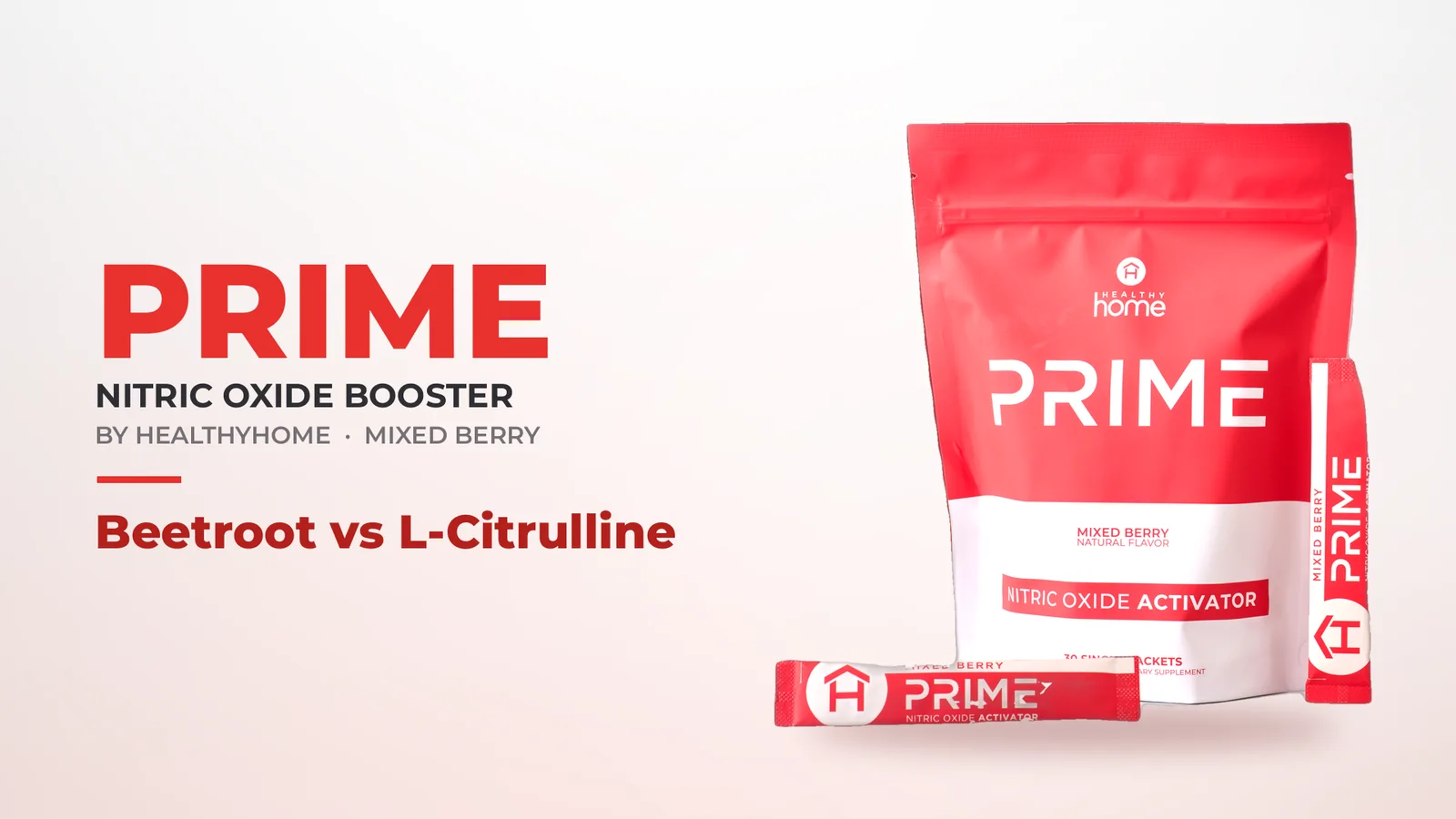
Beetroot vs L-Citrulline: How Each Supports Nitric Oxide
If you’ve read a few nitric oxide labels, two names keep coming up: beetroot and L-citrulline. People often ask which one is “better.” The more useful answer is that they work through different routes, so the beetroot vs L-citrulline question is less of a contest than it looks. Here’s how each one fits, and why HealthyHome PRIME includes both.
healthyhome.world is run by All In Enterprises, LLC, independent HealthyHome distributors. We may earn a commission when you order through our links. This is education, not medical advice.
Quick refresher: why nitric oxide matters
Nitric oxide (N.O.) is a signaling molecule your body makes. It tells the smooth muscle in your blood vessel walls to relax, so vessels can widen and blood can flow freely, carrying oxygen and nutrients where they need to go.* Production tends to decline with age, which is why N.O. support has become a popular part of healthy-aging routines.
Your body has two main ways to make it. Beetroot feeds one. L-citrulline feeds the other.
Route 1: beetroot and the nitrate pathway
Beets are one of the richest food sources of dietary nitrate. HealthyHome’s product sheet adds that beetroot also carries potassium, folate and vitamin C. The nitrate pathway works roughly like this:
- You eat or drink nitrate (from beets, leafy greens or a beetroot extract).
- Friendly bacteria on your tongue and in your mouth convert some of that nitrate to nitrite. HealthyHome’s sheet calls this out: “good bacteria in the mouth initiates the conversion.”
- The body converts nitrite further into nitric oxide, supporting healthy blood flow.*
Two practical takeaways follow. First, the mouth matters, which is one reason PRIME is designed to dissolve on the tongue rather than be swallowed as a capsule. Second, beetroot is food-based, so the same pathway is fed by a salad full of greens. Research on nitrate in older adults is summarized in this systematic review in Nutrients.
A harmless side note people ask about: beetroot can tint urine or stool pink or red.
Route 2: L-citrulline and the amino acid pathway
L-citrulline is an amino acid found naturally in watermelon, among other foods. In the body, citrulline is converted to arginine, and enzymes in the blood vessel lining use arginine to make nitric oxide. HealthyHome’s sheet describes it as increasing plasma arginine levels and supporting nitric oxide metabolism, circulation and athletic performance.*
Why citrulline instead of arginine itself? Citrulline is widely used in N.O. formulas because the body recycles it into arginine; you’ll see it on many circulation and workout labels for that reason.
Side by side
| Beetroot | L-citrulline | |
|---|---|---|
| What it is | Root vegetable extract | Amino acid |
| N.O. route | Nitrate → nitrite → N.O. | Citrulline → arginine → N.O. |
| Helpers | Mouth bacteria start the conversion | Enzymes in the blood vessel lining |
| Everyday food sources | Beets, spinach, arugula, other leafy greens | Watermelon |
| In PRIME | Yes, in the 550 mg blend | Yes, in the 550 mg blend |
So which is better?
It depends on what you’re asking. Because they feed separate pathways, many formulas use both instead of choosing. That’s PRIME’s approach: beetroot and L-citrulline sit together in its Proprietary Prime Nitric Oxide Blend, alongside quercetin, schisandra, pomegranate, pine bark, hawthorn berry and celery seed, plus vitamin C (100 mg) and vitamin B12 (1,000 mcg) per packet.*
One honest caveat: PRIME’s blend is proprietary, so the label shows the 550 mg total, not how much beetroot or citrulline is inside it. If someone tells you a specific milligram figure for PRIME’s citrulline, it didn’t come from the label. For a short tour of the other six ingredients, see nitric oxide booster ingredients, explained.
Where PRIME fits
PRIME comes as 30 single-serve 3.3 g packets in Mixed Berry. You pour a little powder on your tongue, let it dissolve, and repeat until the packet is finished, one or two packets daily per the label. Our how-to-take guide walks through it step by step.
As always, supplements support good habits; they don’t replace them. Eat your greens, keep moving and sleep well. If you’re pregnant, breastfeeding or have a known medical condition, PRIME’s label asks you to consult a physician before taking any supplement.
More on PRIME: PRIME nitric oxide guide: two nitric oxide pathways and the full PRIME blend · PRIME by HealthyHome
Beetroot vs L-citrulline: FAQ
Is beetroot or L-citrulline better for nitric oxide?
They support nitric oxide through different pathways: beetroot through dietary nitrate, L-citrulline through arginine. Many formulas, including HealthyHome PRIME, include both.
Can you take beetroot and L-citrulline together?
Yes, many nitric oxide products combine them. PRIME contains both in one blend. Follow the label, and check with your physician first if you’re pregnant, breastfeeding or have a known medical condition.
Why does PRIME dissolve on the tongue?
PRIME’s directions are to pour a small amount on the tongue and let it dissolve before swallowing. HealthyHome’s sheet notes that good bacteria in the mouth start the nitrate-to-nitric-oxide conversion.
How much citrulline is in PRIME?
The label doesn’t say. L-citrulline is part of a 550 mg proprietary blend, and amounts per ingredient aren’t published.
healthyhome.world is operated by All In Enterprises, LLC, independent HealthyHome distributors. It is not owned or operated by HealthyHome. PRIME is a HealthyHome product. HealthyHome product names and trademarks belong to HealthyHome, LLC. Label details summarize HealthyHome’s PRIME product information as of October 2026; always follow the label on your box. *These statements have not been evaluated by the Food and Drug Administration. This product is not intended to diagnose, treat, cure, or prevent any disease.